Reviving a Silenced Masterpiece
Western-led Project Brings Walter Braunfels’ Sinfonia Concertante to the Stage
A powerful yet long-forgotten work of the violin-viola repertoire is finding new life through a research-led performance initiative spearheaded by Western violin faculty professor Annette-Barbara Vogel, culminating in international performances at the 50th International Viola Congress in Paris.
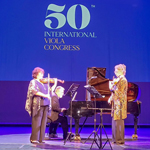
Vogel and violist Jutta Puchhammer-Sedillot, joined by Western Faculty pianist Brett Kingsbury, presented Walter Braunfels’ Sinfonia Concertante for Violin, Viola and Orchestra, Op. 68 in a newly commissioned piano reduction—marking the first time this major work has been made accessible beyond its original orchestral form.
The Paris performance built on an earlier presentation in London, Ontario, as part of Magisterra Soloists’ "Magisterra at the Museum" (MATM) series, founded and artistically directed by Vogel. That first performance as part of the annual “Holocaust” program in January was met with an unexpected standing ovation, affirming the work’s impact despite its unfamiliarity.
“When you take on a project like this, you don’t know how it will land,” said Vogel. “Performing a work that audiences have never heard before always carries a risk. Experiencing such a strong response confirmed that this music speaks powerfully when given the chance.”
Vogel describes the Sinfonia Concertante as exceptionally demanding, with highly idiosyncratic technical and expressive challenges for both solo instruments, set within a dense late-Romantic harmonic language. “It requires a deep commitment beyond the surface of the score,” she said. “Only with sustained engagement can the performers truly persuade an audience.”
Its presentation in Paris placed the project within an international forum of performers, scholars, and educators dedicated to expanding and critically re-examining the viola repertoire.
Braunfels (1882–1954), once among Germany’s most frequently performed composers, was silenced under the Nazi regime when his music was labelled Entartete Musik. As a result, many of his major works—including this large-scale double concerto—disappeared from concert life for decades, not because of musical merit, but due to political erasure.
“Braunfels’ Sinfonia Concertante offers a rare and richly expressive partnership between violin and viola,” said Vogel. “Its refined contrapuntal writing and dramatic scope make it both artistically compelling and pedagogically invaluable. Yet without a usable performance edition, it remained effectively inaccessible.”
At the heart of the project is a new piano reduction of the original orchestral score, created through Vogel’s SSHRC-supported research initiative to address this longstanding gap in the repertoire. The reduction represents the only available performance resource of its kind, transforming a historically marginalized orchestral work into a viable option for recital stages, teaching studios, and academic institutions worldwide.
The initiative exemplifies how artistic research can function as both scholarship and knowledge mobilization: recovering suppressed repertoire, generating new performance materials, and testing them in live performance contexts. It also reflects the international scope of Western-led artistic collaboration, bringing together artists with roots in Canada, Austria, and Germany.
By restoring Braunfels’ Sinfonia Concertante to contemporary performance life, the project contributes to a broader re-evaluation of 20th-century music shaped by political oppression and affirms the role of performers as active agents in historical recovery.
The newly created piano reduction is expected to have lasting impact as an educational and performance resource, encouraging further exploration of Braunfels’ music and expanding opportunities for violin–viola collaboration in concert and academic settings.
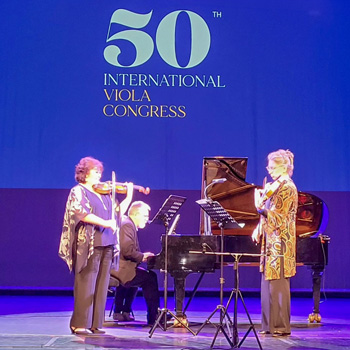
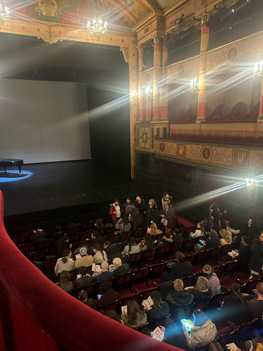
PHOTOS: Performance at the Conservatoire National Supérieur d’Art Dramatique
The theatre at Paris' Conservatoire National Supérieur d’Art Dramatique, built in 1811 by the architect Delannoy, was the site of Hector Berlioz's debut symphony, the Symphonie fantastique, as well as the first French performances of Beethoven's Third and Fifth Symphonies.
Photos provided by Annette-Barbara Vogel