

Search Website
Mohammad Tonkaboni
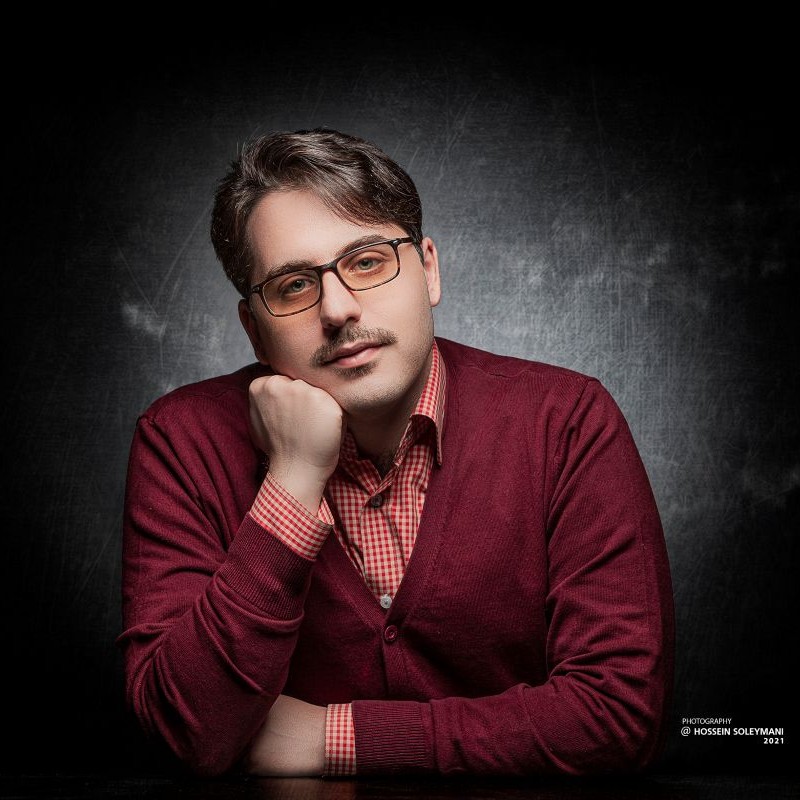
PhD Candidate, Composition
Office: TC 428
Email: stonkabo@uwo.ca
Biography
Mohammad Tonkaboni, also known as Seyed Mohammad Tonkaboni, is an Iranian-born, Canada-based composer, santour player, educator, and doctoral researcher. He is currently pursuing a PhD in Music Composition at Western University’s Don Wright Faculty of Music under the supervision of Professor Paul Frehner.
His creative and research interests include contemporary composition, Persian classical and folk music, orchestral and chamber music, vocal music, electroacoustic practice, computer music, music production, and interdisciplinary artistic research. His work frequently explores the relationship between Persian cultural and intellectual traditions and contemporary compositional practices.
Tonkaboni’s doctoral research investigates how poetry, philosophy, mathematics, and music can interact within a unified compositional system. His current project, The Geometry of Doubt, draws on Omar Khayyam’s quatrains, philosophical thought, and mathematical legacy. In this project, binomial coefficients derived from the Khayyam–Pascal Triangle contribute to decisions involving harmony, rhythm, musical form, and timbre while remaining responsive to expression and performance. Through this research, Tonkaboni examines how doubt, uncertainty, material existence, and present-focused ethics can be expressed as musical processes.
Recent works include A Shadow of Doubt, Atonal Ghazal for clarinet, violin, and piano, and Lullaby for mezzo-soprano, viola, and percussion. His compositions extend across orchestral, chamber, vocal, electronic, and mixed-media settings. He has also composed and arranged music for Persian singers, soloists, chamber ensembles, choirs, and orchestras.
Persian classical music has played an important role throughout Tonkaboni’s artistic development. Works such as Chahargah Is Heard Through the Raindrops!, Kereshmeh, Theme and Variations on a Kurdish Song, The Language of the Speechless, and Sholayle incorporate or transform materials drawn from Persian musical traditions. Rather than directly reproducing traditional materials, he often reinterprets modal structures, melodic gestures, rhythmic patterns, folk songs, and elements associated with the Radif within contemporary musical contexts.
Persian literature is another significant source of his creative practice. His compositions engage with the sound, rhythm, imagery, and philosophical content of Persian poetry, as well as melodic and declamatory traditions associated with its performance. Through these elements, his work considers questions of cultural memory, identity, migration, translation, and the relationship between inherited traditions and contemporary artistic expression.
Tonkaboni’s music has been presented in Iran, Canada, and Europe. His professional activities have included working with the KNM Berlin Ensemble through an international festival organized by the Association of Iranian Contemporary Music Composers and the Shiraz International Music Festival. In 2021, one of his compositions was selected by a committee for performance by the Tehran Symphony Orchestra. Although the planned performance did not take place because of budgetary and administrative changes within the orchestra, the selection represented an important recognition of his orchestral work.
Tonkaboni has also presented papers at academic conferences hosted by York University, the University of Ottawa, and Western University. His conference presentations reflect his interests in contemporary composition, Persian musical and cultural traditions, intercultural approaches to music, and artistic research.
Tonkaboni holds a Master of Arts in Music Composition from the Tehran University of Art, where he graduated in 2018. In 2019, he co-authored the article “A Study of Behzad Ranjbaran’s Seven Passages, with a Focus on Elements of Cohesion and Diversity” with Dr. Amin Honarmand. The article was published in the University of Tehran’s Journal of Fine Arts and is available online.
As an educator, Tonkaboni has taught music theory, instrumentation, orchestration, and related subjects at institutions in Iran, including the Tehran University of Art (recently changed to Iran University of Art), the University of Applied Science and Technology, the Tehran Music School, and the Tehran Conservatory of Music. At Western University, he has worked as a graduate teaching assistant and has continued developing his teaching practice through programs offered by the Centre for Teaching and Learning. His pedagogical interests include active learning, inclusive teaching, intercultural awareness, and making theoretical and creative musical concepts accessible to students from different backgrounds.
Tonkaboni also has experience in artistic administration, publishing, and project leadership. Beginning in 2019, he led the Bang Ava-ye Sarang Art Institute, where he oversaw the publication of albums and soundtracks. He also directed the Parsua Orchestra in music festivals and contributed to the planning and implementation of music projects in Iran.
His professional service has included serving as a judge and selection-committee member for the Navay-e Mehr Music Festival in 2022. He has also held leadership and advisory roles with the National Music Association, the National Choirs at the Institute for the Intellectual Development of Children and Young Adults, the Composers Association of Iran Music House, the Parsua Orchestra, and the Technical Council of Music Theory at the Tehran Music School.
At Western University, Tonkaboni has contributed to graduate student and university service through PSAC Local 610, the union representing graduate teaching assistants and postdoctoral associates. In his role as Chief Returning Officer, he has helped administer election procedures and support fair and transparent graduate-union elections.
Across his work as a composer, educator, researcher, and community member, Tonkaboni seeks to create meaningful connections among Persian cultural sources, contemporary musical practices, technological approaches, and broader questions of identity and human experience.